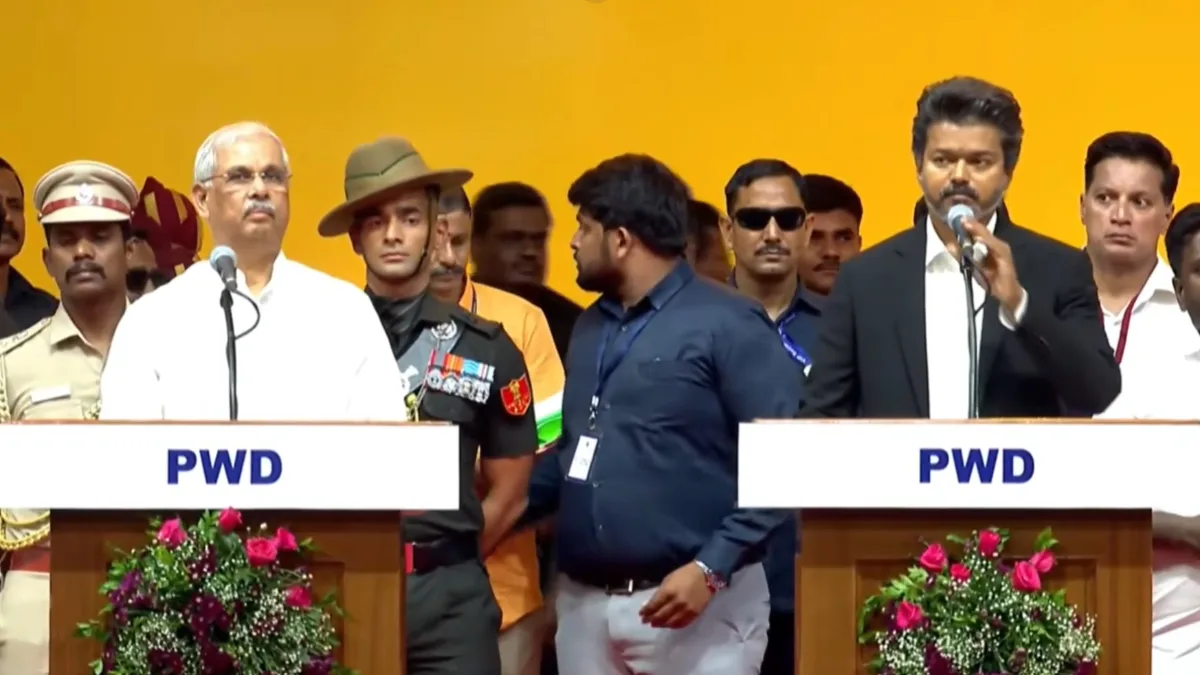
After scripting a historic political rise in Tamil Nadu, Chief Minister C. Joseph Vijay and his newly sworn-in Tamilaga Vettri Kazhagam (TVK) government will face its first major political challenge, a crucial floor test in the Assembly that will decide the fate of the government.
Though the swearing-in ceremony marked the formal arrival of TVK to power, the Vijay-led administration cannot fully begin functioning until it clears two key constitutional procedures in the Assembly: the election of the Speaker and the vote of confidence. With the ruling alliance holding only a slender majority, every MLA is expected to play a decisive role in the coming trust vote.
Advertisement
Governor Sets Deadline for Majority Test
Tamil Nadu Governor Rajendra Vishwanath Arlekar has directed the new government to prove its majority on or before May 13, setting the stage for intense political activity inside the Assembly.
The first step in the process will be the election of the Speaker and Deputy Speaker. The ruling alliance is expected to field its nominee for Speaker, while opposition parties may contest the post by putting forward their own candidate, potentially triggering a direct showdown on the Assembly floor.
If a contest takes place, voting will be conducted in the House, and the winning candidate will officially assume the Speaker’s chair. In case of consensus, the traditional practice of the Chief Minister and the Leader of the Opposition escorting the newly elected Speaker to the Chair is likely to be followed.
Confidence Motion to Decide Government’s Future
Following the Speaker’s election, the government is expected to move a confidence motion either later the same day or on May 13.
A member from the treasury benches will introduce the motion seeking the confidence of the House, after which Chief Minister Vijay is expected to deliver his first major address in the Assembly, appealing for support for his government. Opposition leaders are also expected to participate in the debate before voting begins.
The trust vote is likely to be closely watched and politically charged, particularly if the opposition demands a division vote. This formal voting process records each MLA’s individual stance.
Tight Numbers Raise Political Stakes
Under Assembly rules, once a division vote is sought, the Speaker is required to permit it. Bells will be rung three times to summon legislators into the House before the voting process begins. After the Assembly doors are closed, the Secretary of the House will conduct division-wise voting across six sections of the Assembly.
MLAs supporting and opposing the motion will stand separately during the count. Traditionally, the Chief Minister sits in the first division, while the Leader of the Opposition occupies a seat in the sixth division directly opposite.
The final tally will then be handed over to the Speaker, who will announce whether the government has secured the confidence of the House.
If the motion is passed, the Vijay-led government will officially continue in office. However, defeat in the floor test could push the state into political uncertainty, with the Governor empowered to initiate steps that may eventually lead to the fall of the government.
With numbers expected to remain tight, the attendance of every MLA from the ruling alliance is being seen as critical ahead of one of the most significant Assembly tests in recent Tamil Nadu politics.